You know about the Employment Rights Act. Are you ready for it?

Most HR leaders could sum up the Employment Rights Act in a couple of sentences. Far fewer could show you the pay data, contracts and probation process that prove they’re ready for it.
Our view? The Act isn’t one deadline. It’s a rolling set of changes to pay, contracts and the first six months of every job. In other words, it’s a clear example of continuous transformation.
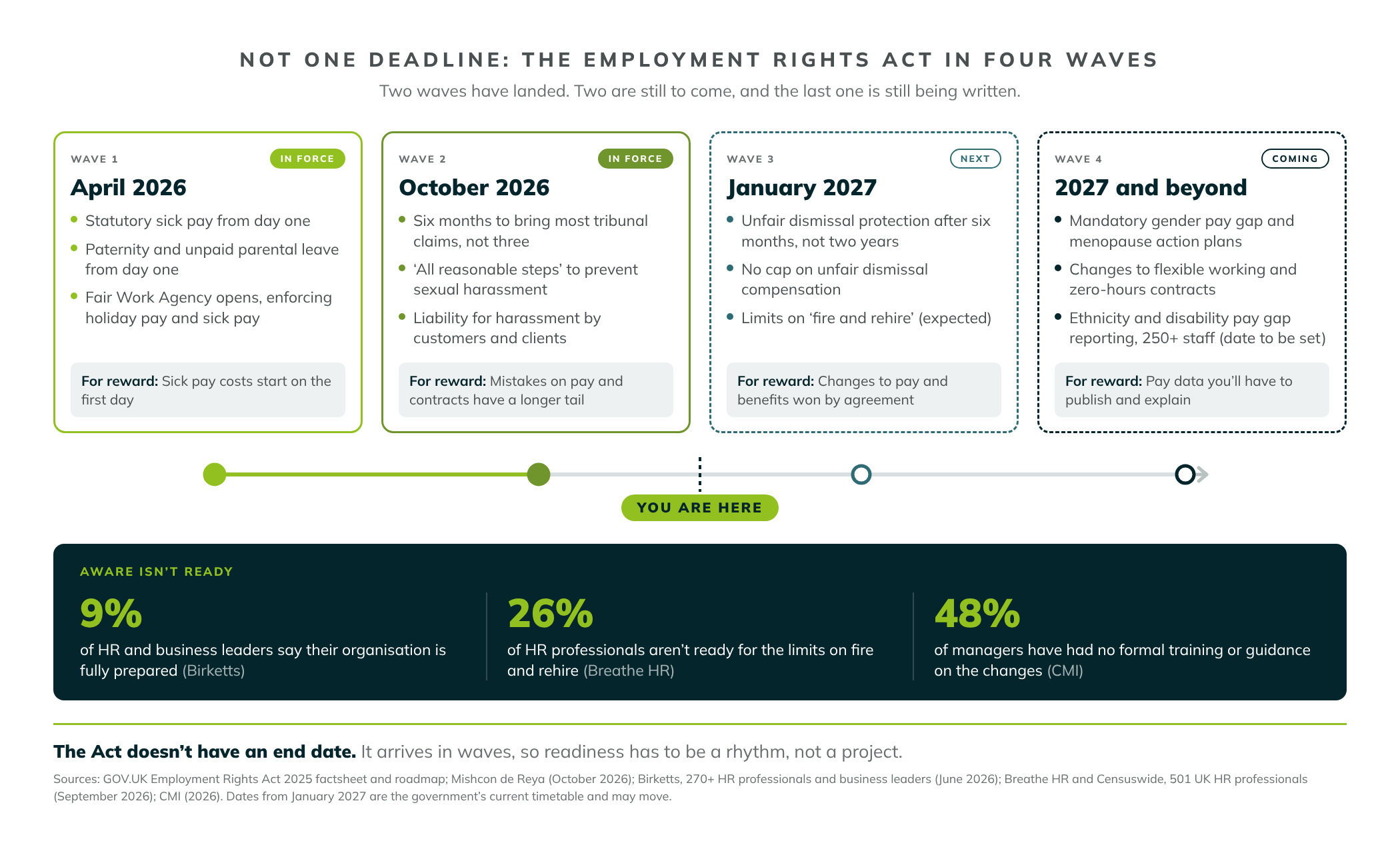
The surveys say the same thing - When law firm Birketts asked more than 270 HR professionals and business leaders this summer, only 9% said their organisation was fully prepared, with 81% said ‘somewhat’, which is a fairly significant delta.
In September, a Censuswide poll of 501 UK HR professionals for Breathe HR found that 22% weren’t ready for the longer deadline for tribunal claims that started on 1 October, and a quarter (26%) weren’t ready for the new limits on ‘fire and rehire’. And as we talked about in Part six of our Continuous Transformation campaign, 48% of managers say they’ve had no formal training or guidance on the changes they’re expected to apply.
Not one deadline, but four waves
This is the last part of our Age of Continual Transformation series, and where in Part one we asked why every transformation programme still has an end date, today’s piece looks at how The Employment Rights Act doesn’t have one. It became law last December and is arriving in waves across 2026 and 2027:
- April 2026: Statutory sick pay and paternity leave from day one, new Fair Work Agency, which will also enforce holiday pay and sick pay.
- October 2026: Six months instead of three to bring most tribunal claims, a duty to take ‘all reasonable steps’ to prevent sexual harassment, new liability for harassment of staff by customers and clients.
- January 2027: Unfair dismissal protection after six months’ service instead of two years, with the cap on compensation removed, new limits on ‘fire and rehire’ expected.
- Later in 2027 and beyond: Mandatory gender pay gap and menopause action plans for larger employers, changes to flexible working and zero-hours contracts, ethnicity and disability pay gap reporting for employers with 250 or more staff – dates still to be set.
Why it lands on reward
It’s tempting to hand all of this responsibility to the lawyers. But look at what it touches: sick pay, probation, whether you can change someone’s pay or benefits, and what you’ll have to publish about pay gaps. Most of that is within the reward team, the wider HR team, working closely with the legal team.
Take ‘fire and rehire’. When consultation on a new pay or benefits structure stalled, some employers took the approach of dismissing staff and re-engaging them on new terms. From January, dismissing someone for refusing a change to their pay, pension, hours or holidays is expected to be automatically unfair, so any reward change in 2027 will have to be won by agreement.
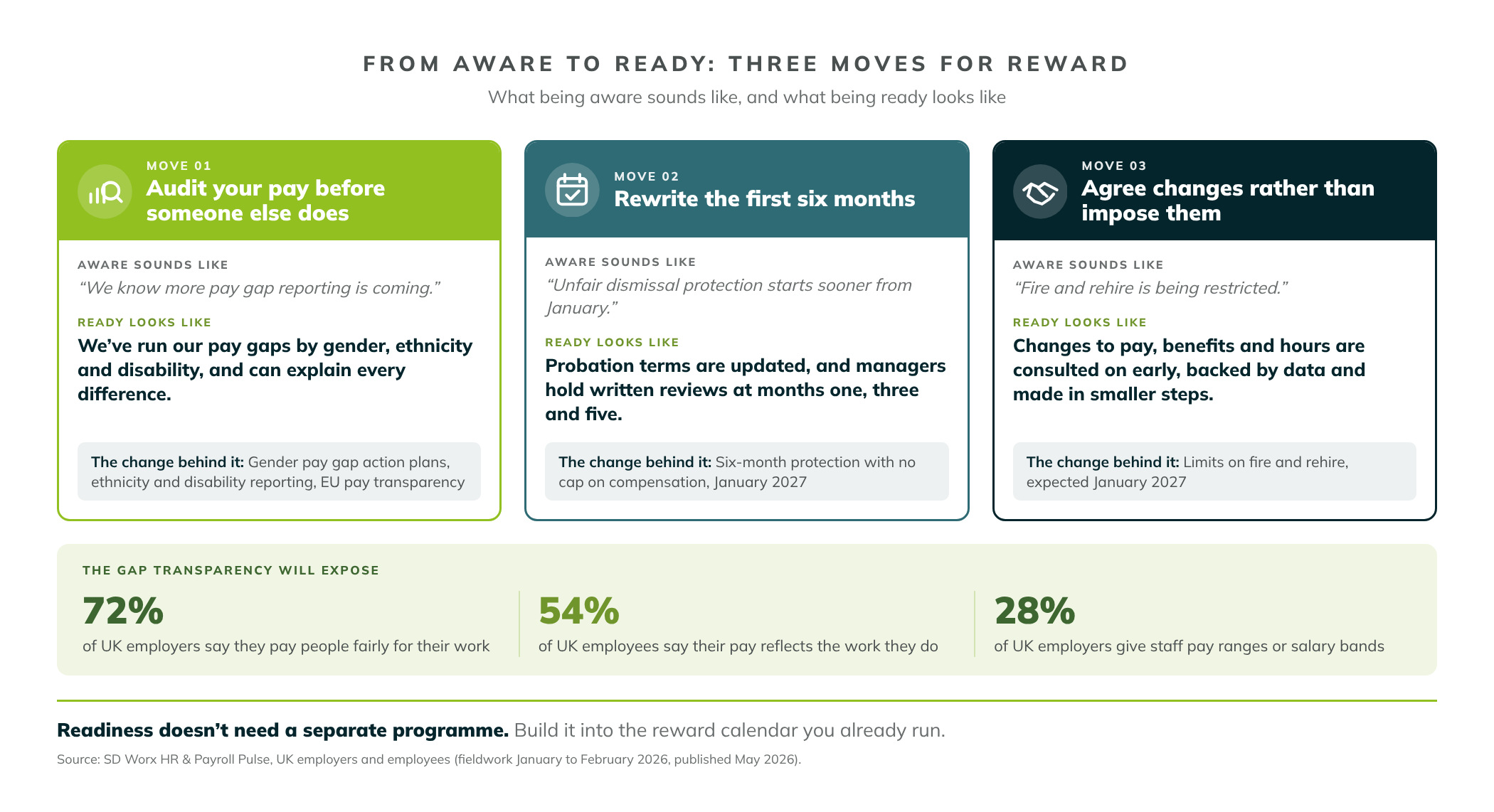
Then there’s transparency. Employers with staff in the EU are already working through the EU Pay Transparency Directive, which member states were due to adopt by June 2026. What does it include? Pay ranges before interview, no questions about pay history, and a joint pay assessment wherever a gender pay gap of 5% or more can’t be explained. That kind of scrutiny exposes gaps employers can’t see from the inside. In SD Worx’s survey this year, 72% of UK employers said they pay people fairly, but only 54% of UK employees said their pay reflects the work they do. Just 28% of employers give staff pay ranges or salary bands.
“Awareness lives in a briefing paper. Readiness lives in your pay data, your contracts and your managers’ diaries.”
And all of this is happening with a limited budget. Brightmine puts the median pay award, the typical rise in base salary, at 3.1% in the three months to the end of September. Employers expect it to hold at around 3% next year, with affordability and higher employer National Insurance costs both squeezing budgets. The pot isn’t getting bigger. The rules on how you spend it, and how you explain it, are getting tighter.
It’s also the quietest line in our own research. In our Convergence Agenda work (research we carry out ahead of each Working Futures event), roughly one in six senior people leaders named macro turbulence, regulation included, as a defining pressure. Yet reward and pay don’t feature in the twelve investment areas from our 2026 delegate cohort data, from AI at 71% down to employer branding at 24%. This suggests that although the law is landing on reward, the money is going elsewhere.
From aware to ready
Readiness doesn’t need a separate programme. For reward, we’d start with three moves:
- Audit your pay before someone else does. Run the numbers you’ll eventually have to publish, by gender now and by ethnicity and disability next. It’s worth checking that every difference has a reason you’d be comfortable explaining. If you employ people in the EU, add pay ranges to the list.
- Rewrite the first six months. From January, six months is when unfair dismissal protection starts, with no cap on compensation. As Birketts found, more than 83% of respondents will almost certainly revise their probation terms before then. New wording only helps if managers use it, so build written reviews into months one, three and five: the operating rhythm from Part six of our series, applied to the riskiest six months of employment.
- Agree changes rather than impose them. With ‘fire and rehire’ largely off the table, any change to pay, benefits or hours needs a case people accept. Consult early, show them the data, develop an effect change management approach and make smaller changes more often rather than one big restructure every few years.
There’s a productivity question here too. Breathe HR found that 63% of HR professionals say the reforms have made their leadership more cautious about hiring. If every hire becomes a bigger commitment after six months there are knock on effects across the organisation. It may increase workload for existing employees - especially line managers who navigate the probationary period for new team members or hiring teams who need to more closely match candidate skills with roles.
Closing the loop
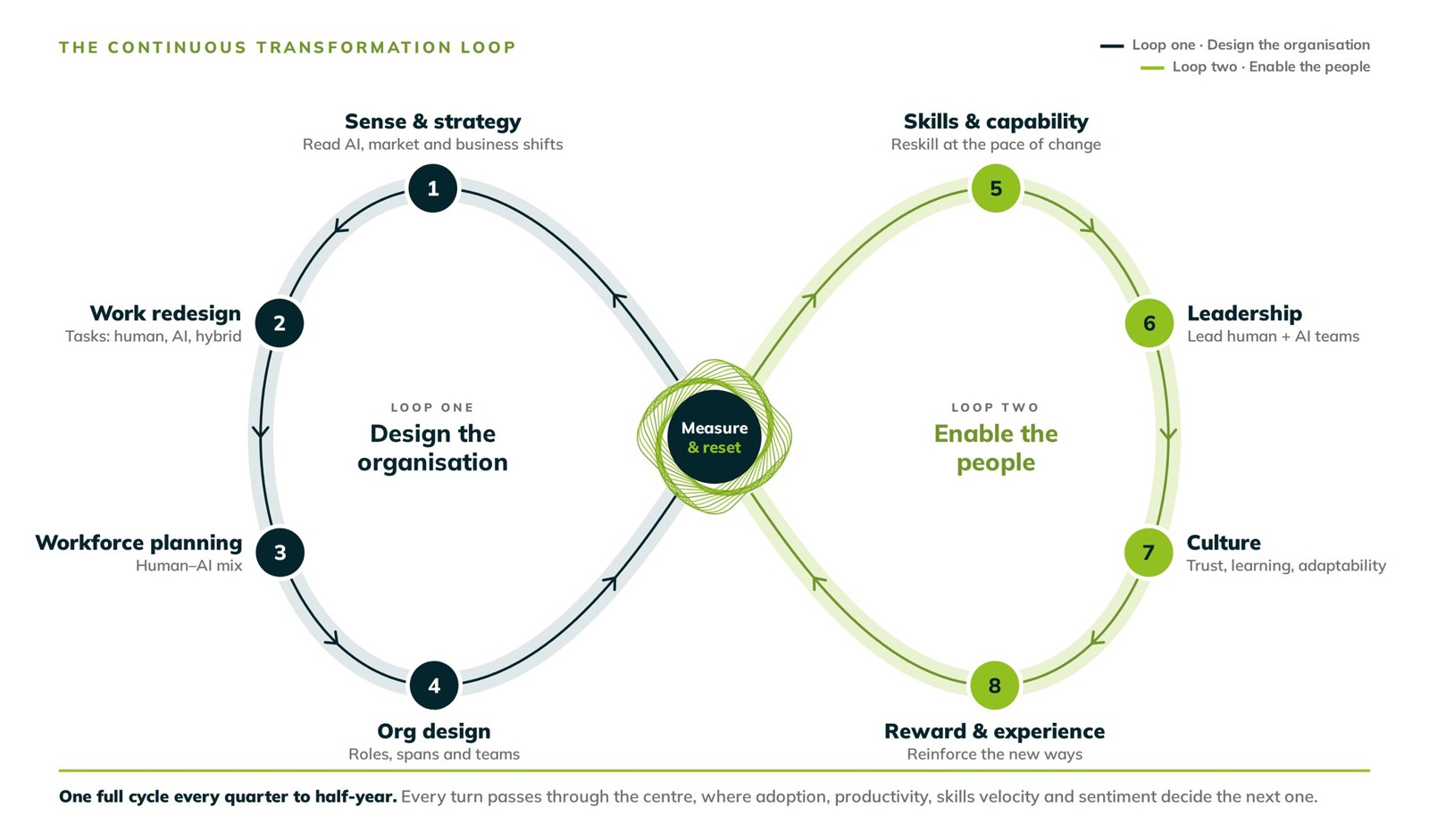
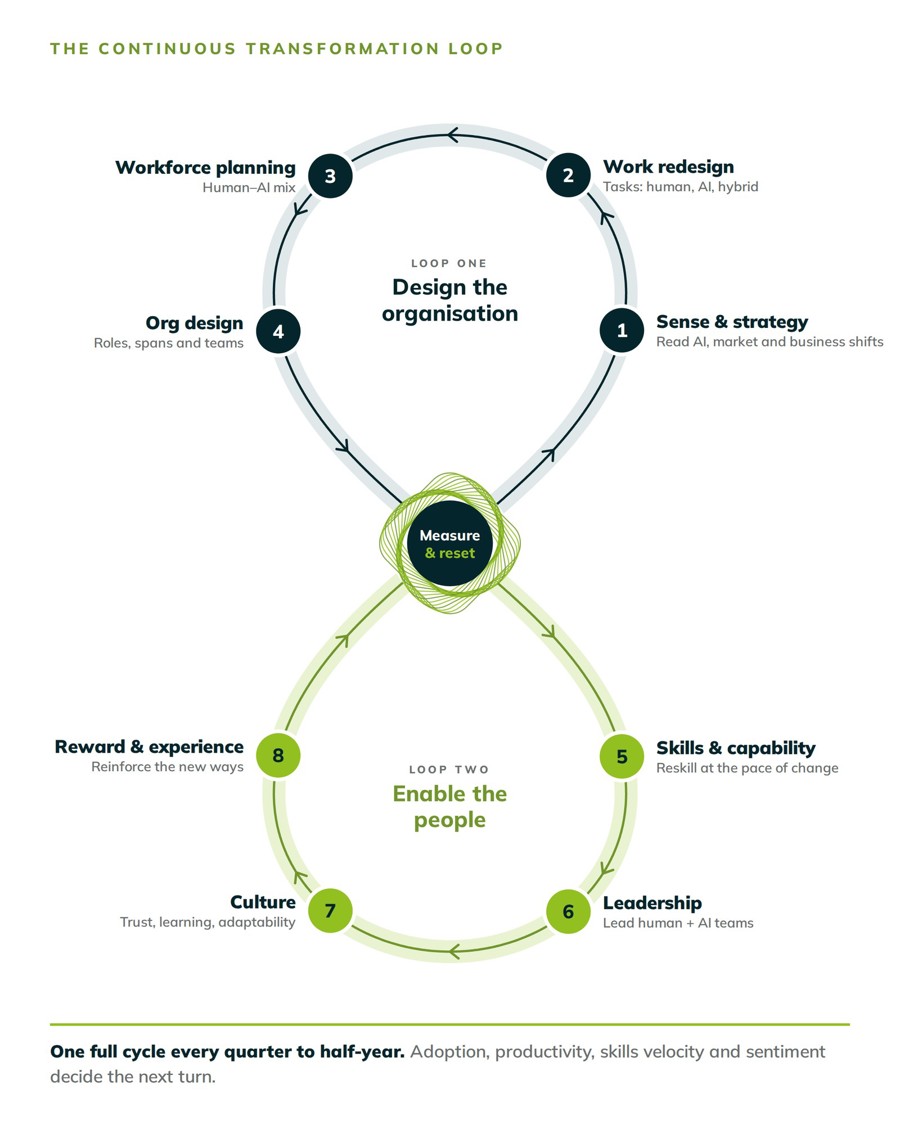
In the continuous transformation loop we set out in Part two, reward is the last step before ‘measure and reset’: the part that reinforces new ways of working, or quietly undermines them. Through this eight part Continuous Transformation series we’ve worked our way round the loop below. Our argument? The Employment Rights Act is the same loop written into law. It won’t be finished in January or at the end of 2027, and the organisations that cope best will be the ones already treating change as a rhythm rather than a project.
Join us at Working Futures
If you’d like to speak with fellow HR professionals about what you’ve read above, join us for our upcoming event. Reward, Pay & Productivity is one of the seven topic pillars at our Working Futures on Tuesday 24 November in London, with O.C. Tanner as its stream partner. We will be running five sessions on the topic including:
- 10:00 Pay Transparency & Equity: Getting Audit-Ready
- 11:00 Skills-Linked Reward: From Roles to Capabilities
- 12:00 Productivity & Time: Evidence-Led Redesign of Work
- 14:00 Benefits that Matter: Financial Wellbeing & Choice
- 15:00 Recognition that Drives Outcomes
That’s the end of the series, but not the conversation. We’ll be taking all seven pillars and 35 sessions into the room on 24 November. Register your interest here.
Part 8 of The Age of Continuous Transformation, the final part of our eight-part series in the run-up to Working Futures on Tuesday 24 November 2026. Read the full series →