Most HR teams have done something with AI. How many can show it paid back?

The money has been spent on that expensive AI transformation project, yet the returns are harder to find. Is it the technology? It might have less to do with it than you think…
Ask an HR director what their function has done with generative AI and you’ll get a list that reads fairly standardly; there’s a chatbot answering policy questions, copilots switched on for the team, a pilot in recruitment and another in learning. Ask the challenging question, “yes, but what has it delivered in terms of tangible returns?”, and the answer you get back is vague. Or at least, that’s what we’ve found from our conversations with CPOs, CHROs and senior HRDs within the businesses we’ll be seeing at Working Futures this year.
For the last couple of years AI spend has been treated as a bet on the future, with no business seeming to be sitting it out. That grace period is ending, because CEOs and Finance directors want to know what the money bought, and there are plenty of HR teams out there that can’t give them a clean answer.
Don’t put your numbers on a slide!
This isn’t only an HR problem. Depending on whose research you read, somewhere between one in 20 and one in four AI initiatives deliver the return they were meant to. MIT’s study of enterprise deployments last year sat at the low end: 95% of generative AI pilots showed no measurable impact on profit and loss. IBM’s 2025 survey of 2,000 chief executives found only a quarter of AI initiatives had delivered the return expected of them. Deloitte’s survey of more than 1,800 senior executives across Europe and the Middle East found 15% of organisations using generative AI were seeing significant, measurable ROI.
On our agenda we’ve called it one in five. Whichever study you trust, the point is the same: a lot of money is chasing a small number of successes.
What we’re hearing from HR leaders about AI
In our Convergence Agenda research with 101 senior people leaders, AI is comfortably the most-cited challenge of 2026. 55% put it in their top three, eleven points clear of anything else. It’s also where the money is going: 71% of the senior delegates registered for our 2026 programmes are actively investing in AI or machine learning.
What sits around that number is more interesting. The same community is funding change management (37%), workforce planning (38%) and upskilling (31%), which means they’re paying for the organisation to be able to use the tools, not just buying them. And when leaders describe what could stop AI paying back, the answer usually isn’t the technology, but their people’s confidence. One HR leader summed up their priority for the year as “Data & AI transformation of HR from support to performance enabler” – that’s a long way from switching on a chatbot.
What the one in five do differently
The gap between the deployments that pay back and the ones that don’t is rarely about which product was chosen. It comes down to four things decided before anyone logged in:
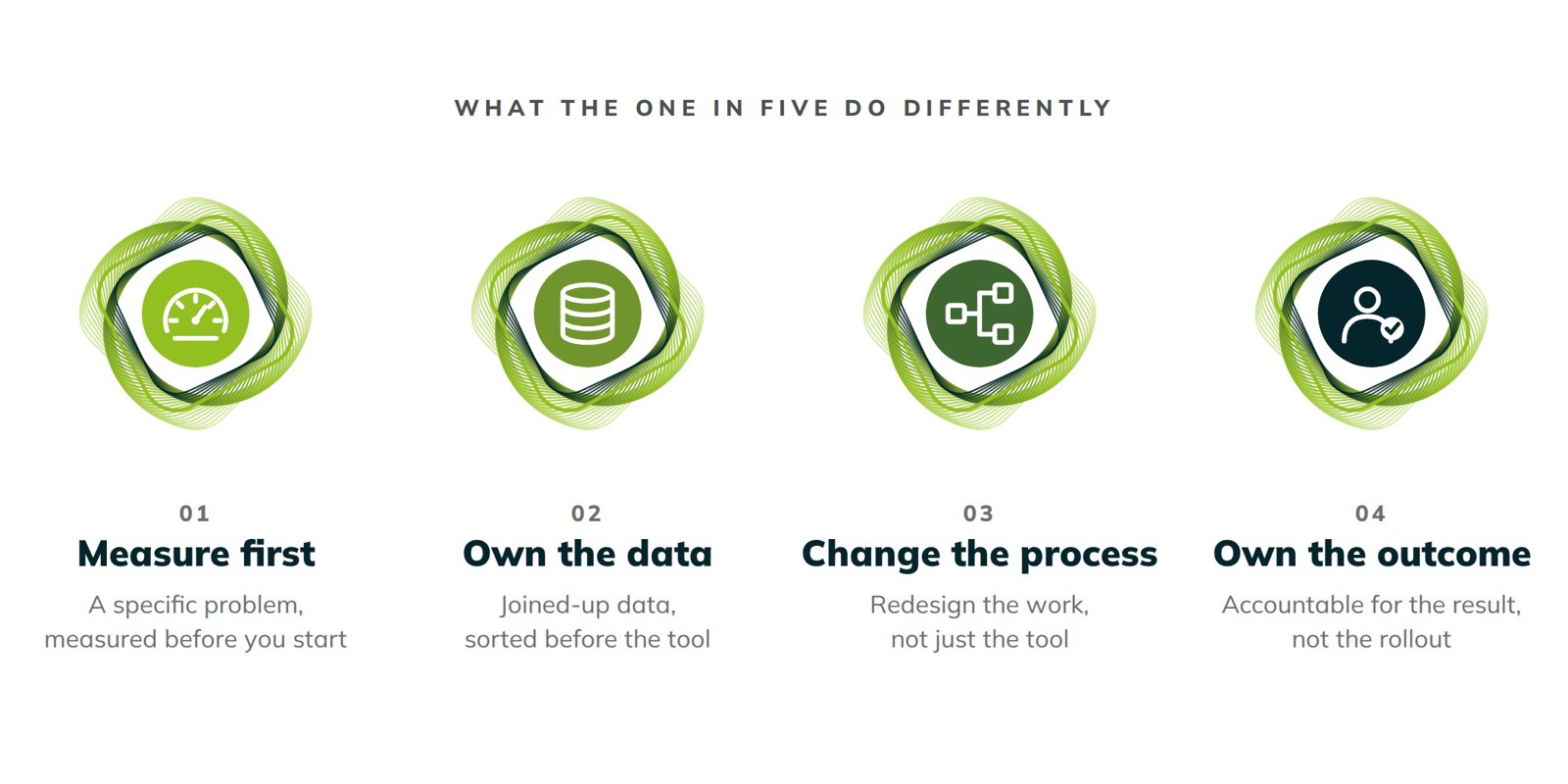
- They picked a specific problem and measured it first. “Use AI in recruitment” isn’t a use case. “Cut the hours our hiring managers spend screening CVs for high-volume roles” is. Without a before there’s not an after.
- They own the data it runs on. In a lot of HR functions the data sits across three systems, two spreadsheets and someone’s inbox. The organisations getting returns fixed that first or picked a problem where the data was already in decent shape.
- They changed the process not just the tool. Put AI on top of the old way of working and you tend to get the old results slightly faster. The returns come when the work itself is redesigned around what the tool can now do.
- Someone owns the outcome. Not the rollout - the outcome. A named person whose job it is to show, six months on, what changed.
None of that is technical - all of it is the kind of work HR is supposed to be good at.
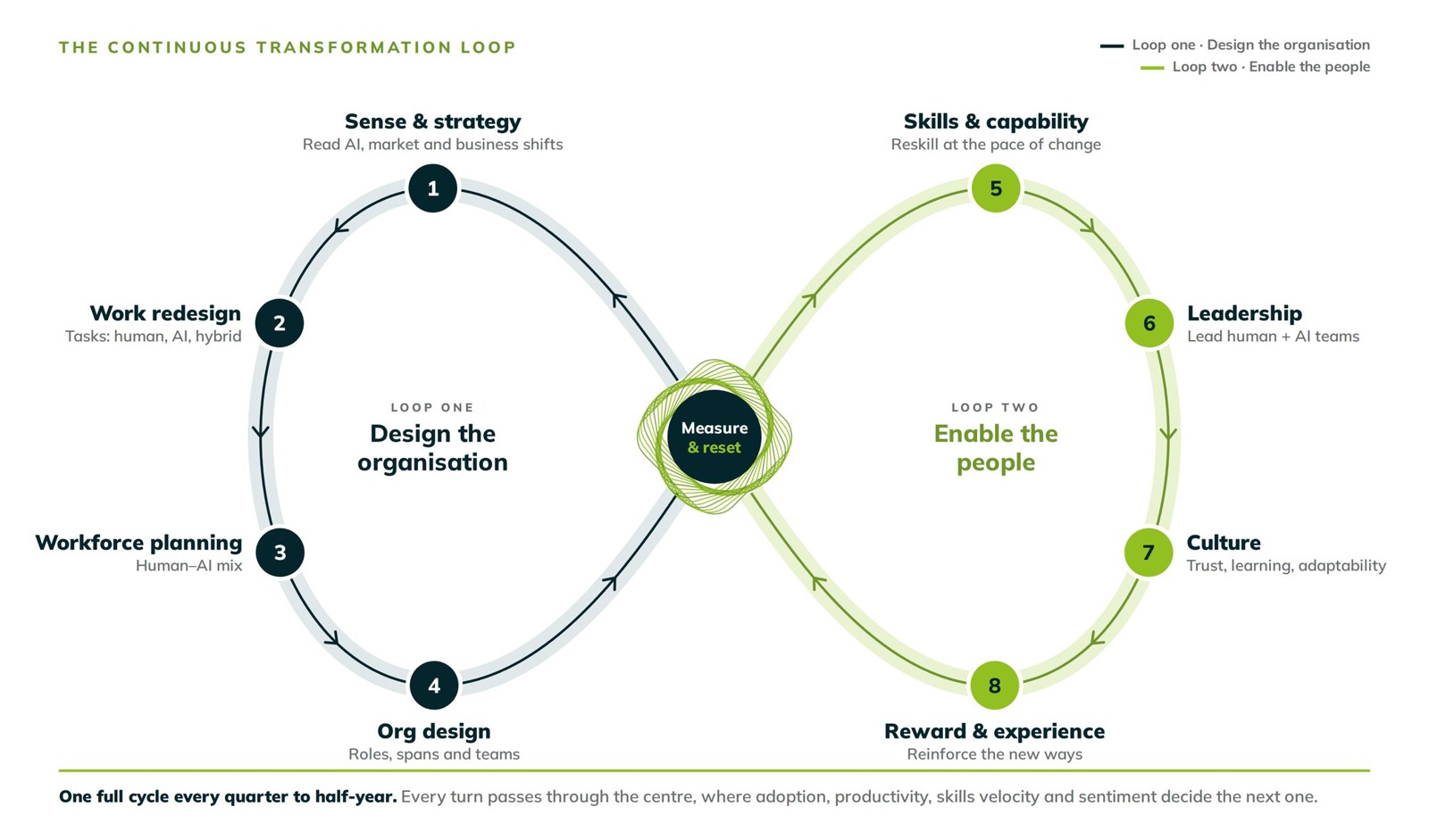
Once you understand that you can have ‘digital people’ – agents actually performing tasks and making decisions, it changes the landscape of everything else you need to look at: Org Design, Strategic Workforce Planning, Skills & Capabilities, Leadership, Culture and so on.
This is moving so fast, that you need to change the way to transform.
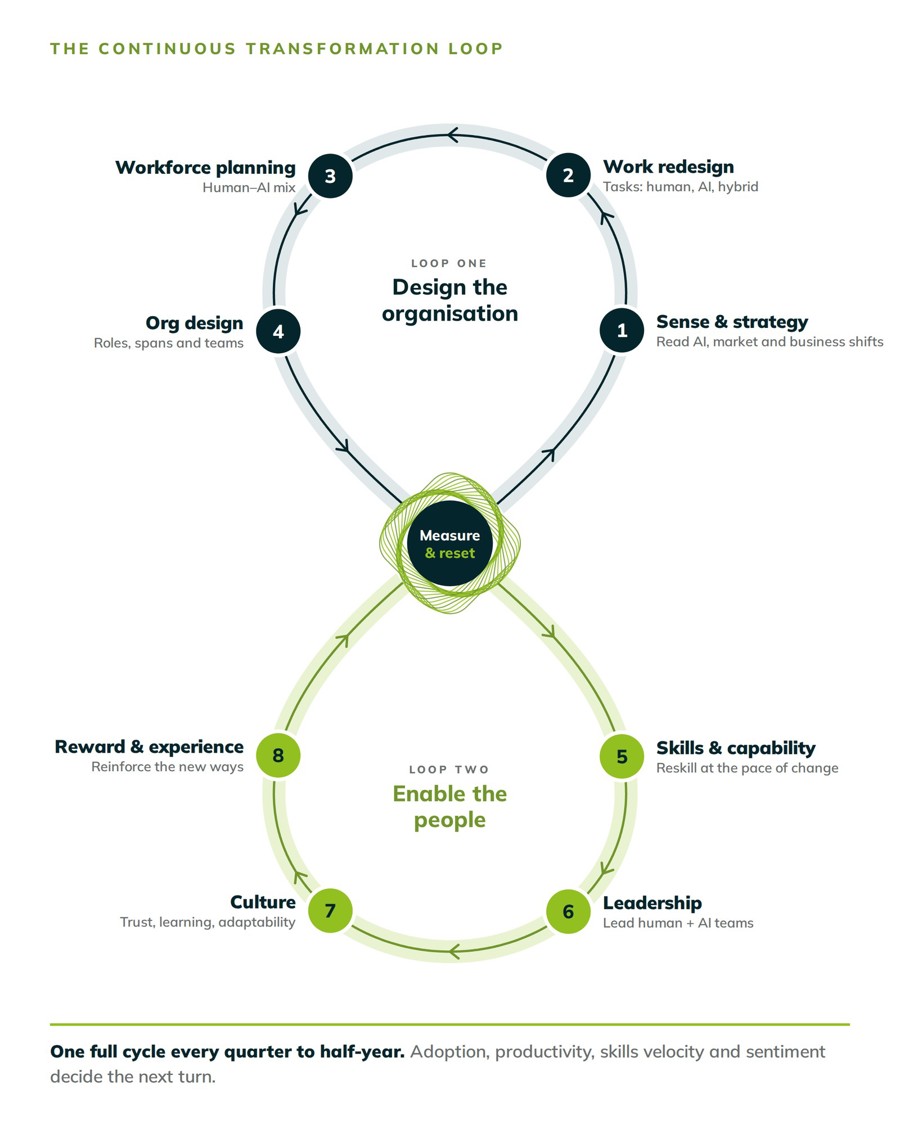
- Sense & strategy opens every cycle. Read what AI, the market and the business have changed since the last turn.
- Work comes before structure. Redesign tasks first, or you restructure around jobs that are already dissolving.
- Workforce planning sizes the mix. Decide what human, AI and contingent capacity the redesigned work needs, and whether to build, buy, borrow or automate it.
- Org design closes the loop. Shape roles, spans and teams around that mix, then hand the defined roles to the people loop as skills requirements.
The people loop then picks up from there, building the skills, leadership and culture those roles need to work.
We’re talking about it as ‘Continuous Transformation’ for a reason…
The instinct is to run AI as a programme: you pick the platform, run the pilot, roll it out, move on. That’s the model the first article in this series argued has stopped working. AI doesn’t have a go-live date after which things settle down. The tools change every few months and the regulation is still arriving: most AI used to hire, manage or monitor people counts as high-risk under the EU AI Act. Each new capability also changes the skills, roles and management it depends on.
The payback question is really about whether the organisation can keep absorbing change, not whether it bought the right product. That makes it HR’s question twice over: once as a function buying AI for itself, and again as the function responsible for the people expected to make it work everywhere else.
Three questions worth asking before your next AI business case:
What would we measure to know this had paid back, and have we measured it today?
Who owns the outcome, by name?
Are we investing as much in our people’s confidence to use it as we are in the tool?
Taking it into the room
At Working Futures on 24 November, AI & the Reinvention of HR is the first of our seven pillars. Its flagship session, “GenAI ROI: separating the 1-in-5 successes from the hype”, is built around the organisations that can show a return, what they did differently, looking at the ones that didn’t.
Part 2 of The Age of Continuous Transformation, our eight-part series in the run-up to Working Futures on Tuesday 24 November 2026. Read the full series →