Stop trying to inspire change. Put it in the diary.

Most change is launched with a lot of energy and then handed to managers to keep going, often without training, time or systems to do it with.
Our view? The change that sticks tends to live in the working week, not the town hall. Change needs to be intentional and baked into your teams’ working lives.
Most of us have sat through some version of it. There’s a town hall, a video from the chief executive, a new set of values on the screen, and a cascade pack for managers and a request to ‘bring your team on the journey’. The room leaves with a bit of energy. Three weeks later, most teams are working exactly as they were before. No one disagreed with the message, but nothing in their week actually changed.
In the last part of our series we looked at what happens to the work when AI takes a layer out of the org chart, and how much work ends up with the managers who are left. This week is about what we ask those managers to do next, because whether a change sticks is decided far more often in a Tuesday team meeting than it is on a stage.
Inspiration has a short shelf life
Organisations seem to know where the risk sits, even if they don’t say it out loud. In our Convergence Agenda research with 101 senior people leaders, only 23% put leadership in their top three challenges, yet among the 90 senior delegates registered for our 2026 programmes, leadership development is the joint third biggest area of investment (38%). Few executives will volunteer ‘our leadership’ as the problem, but the budget says otherwise. The thing being bought is often the ability to lead people through change.
The question is what that money is spent on. A lot of it still goes on inspiration: the leadership programme, the away day, the big launch. We run events for a living, so we’re not about to tell you a great day in a room has no value. But the energy from a good day fades quickly unless there’s something in the following weeks to harness it, and in most organisations that ‘something’ is supposed to be the line manager.
The manager is where change lives or dies
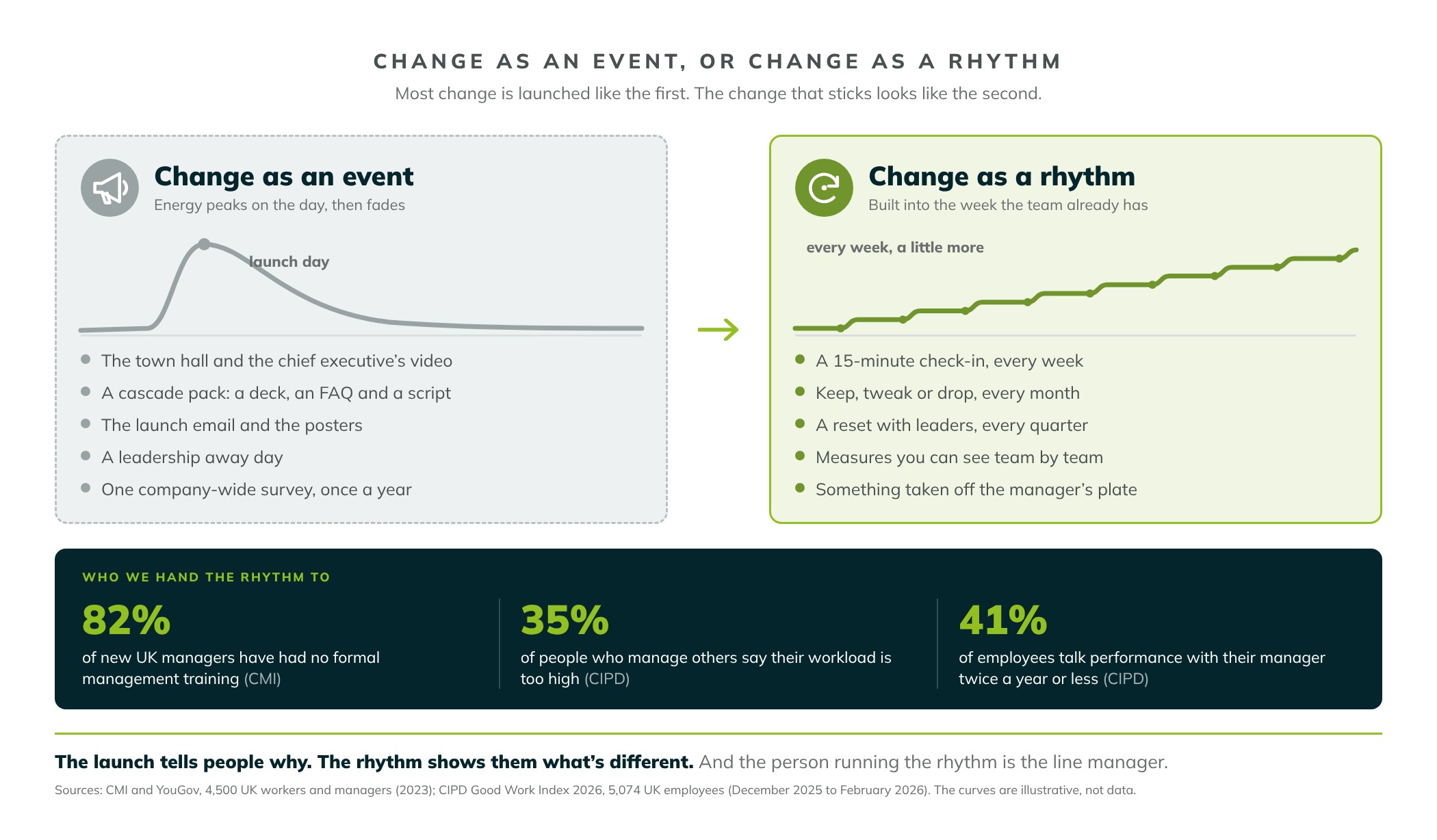
Let’s take a closer look at who we are handing organisational change responsibilities to. Line managers have hit the headlines for their tricky place in modern businesses for good reason. The Chartered Management Institute found that 82% of people who step into management in the UK have had no formal management or leadership training, hence the common phrase ‘accidental manager’.
Its research this year found that:
- Only 12% of managers feel very confident leading AI-enabled teams
- 48% have had no formal training or guidance on the Employment Rights Act changes they’re now expected to apply.
Then there’s the time. The CIPD’s Good Work Index 2026, based on more than 5,000 UK employees, found that 35% of managers say their workload is too high, compared with 28% of people who don’t manage anyone.
Finally, if we want line managers to influence their teams, it relies on regular communication that may not be taking place. Only 57% of employees say their manager gives them useful feedback, and 41% only meet their manager to talk about their performance twice a year or less, or never.
With their own work commitments, lack of training and time, cascading change initiatives is a lot of responsibility to put solely on middle management. But get it right and it pays off: in the same CMI research, half of workers with an ineffective manager planned to leave within a year, compared with just 21% of those with an effective one. Managers can be the biggest lever a change has, if they’re given the time, space and training to do it.
“A town hall can tell people why things are changing. Only the working week can show them what’s actually different.”
From inspiration to system
The organisations that make change stick stop treating it as a message to deliver and start treating it as a rhythm to run. An operating rhythm is just the regular, predictable set of moments when a team talks about how the work is going, tries something, and decides what to keep. Most teams already have the bones of one. The trick is to put the change into those moments, rather than bolting a separate ‘change workstream’ on top of them.
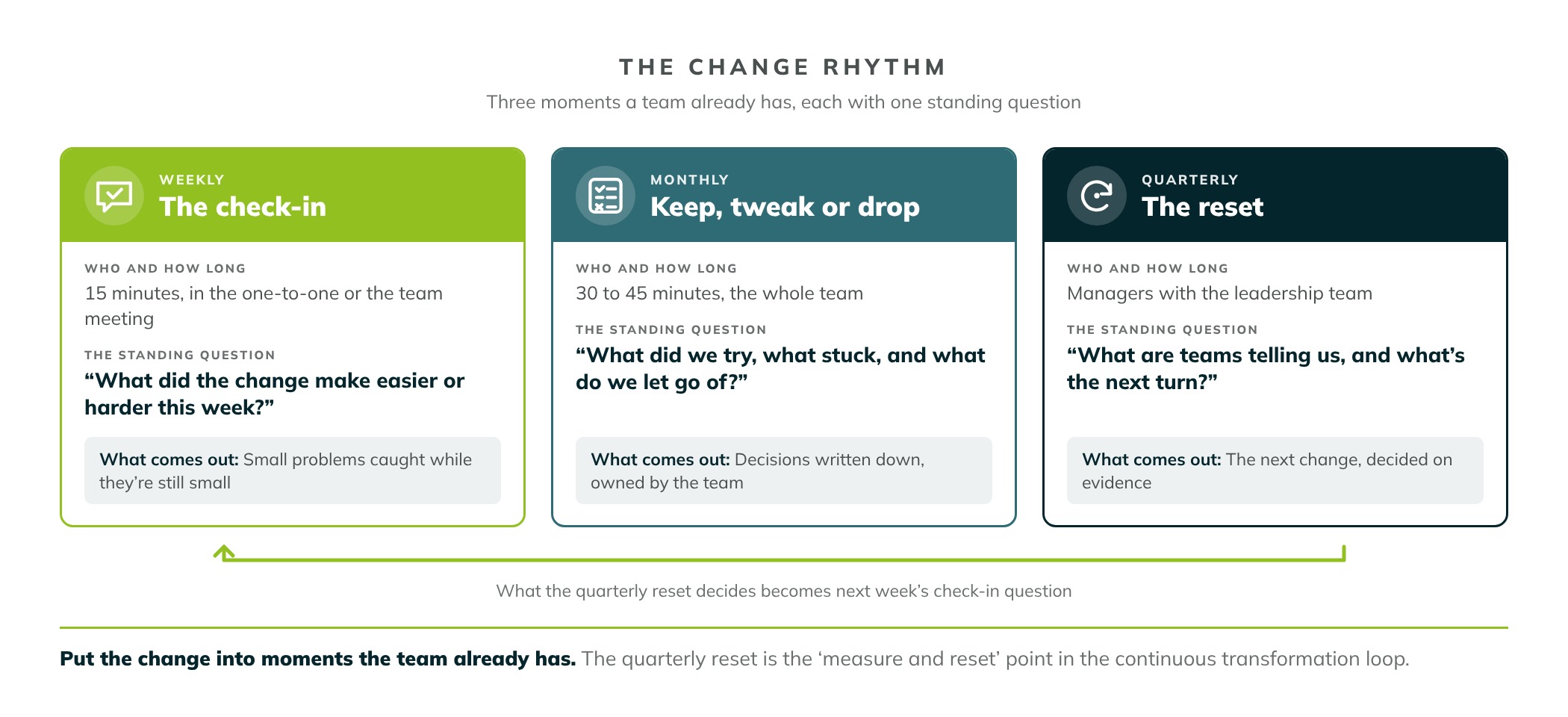
In practice, we’d build it around three key moments:
- Weekly: the check-in. Fifteen minutes in the one-to-one or the team meeting, with one standing question: what did the change make easier or harder this week? It surfaces problems while they’re still small, and it tells people the change is still being taken seriously.
- Monthly: keep, tweak or drop. A short team review of what you tried, what stuck and what to let go of, with the decisions written down. This is where a team stops waiting to be told and starts owning how it works.
- Quarterly: the reset. Managers take what they’ve heard up a level, and leaders decide the next steps. This is the ‘measure and reset’ point in the continuous transformation loop we set out in Part two, and it’s what stops a change drifting back to the old way once the attention moves on.
What it asks of HR
None of this works if it’s just another thing on a manager’s list. If a rhythm is going to carry the change, something else has to come off the plate, and the people running it need to be trained for the conversation rather than the cascade. That means coaching a team through a change, not presenting it to them, and being able to have awkward conversations early. A quarter of UK employees told the CIPD they’d experienced conflict at work, and just over half of them (51%) simply let it go. A regular check-in is often the only place those disagreements surface before they turn into something more formal.
It also means measuring the rhythm itself, not just the change. Are the check-ins actually happening? Are the monthly decisions being written down? The CIPD found that employees who meet their manager more often rate that manager more highly, which suggests the habit matters as much as the content.
Taking it into the room: join us for a conversation
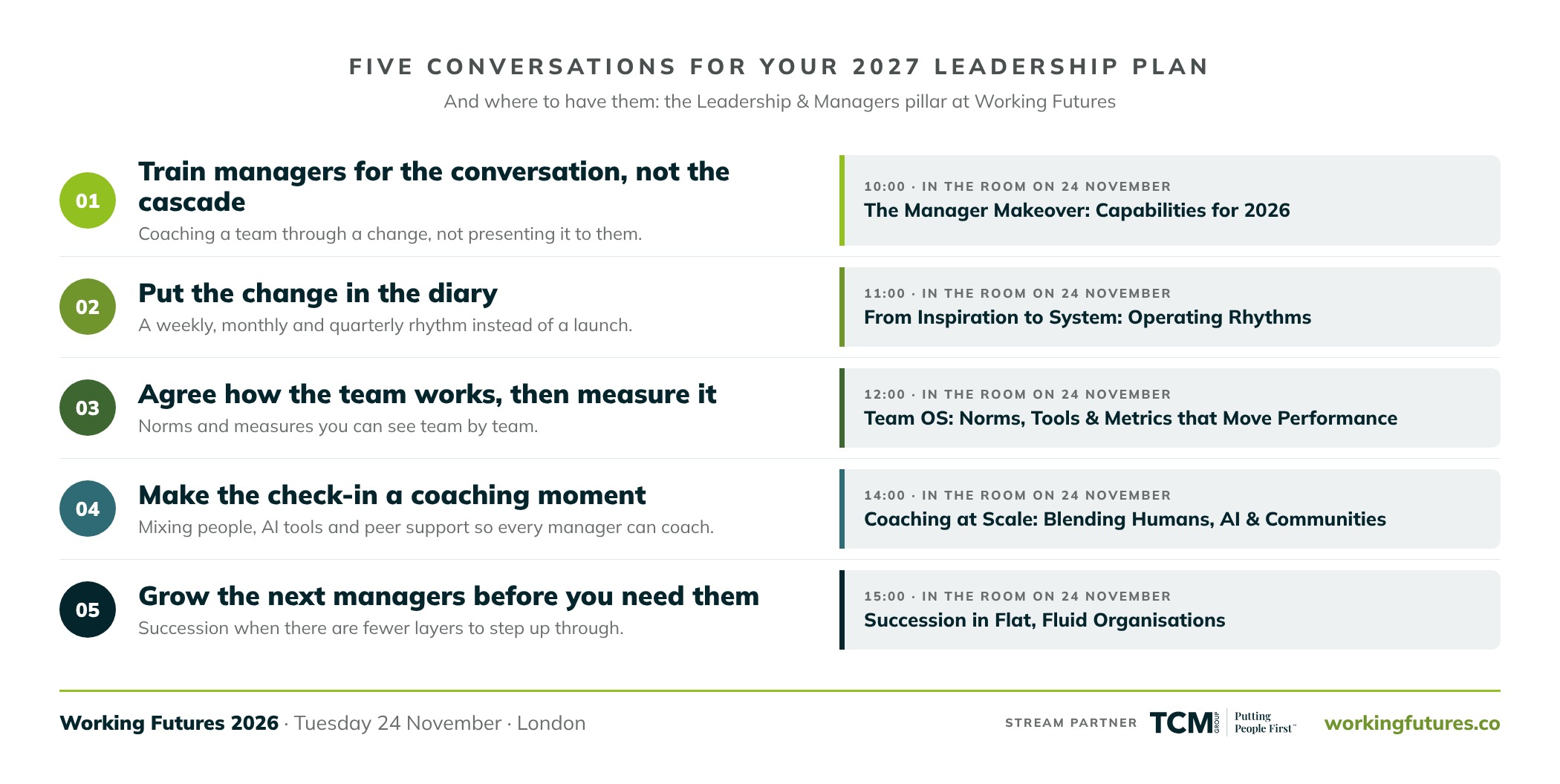
Leadership & Managers is one of the seven pillars at Working Futures on Tuesday 24 November in London, with The TCM Group as its stream partner. TCM’s founder, David Liddle, opens the day with what is sure to be a great keynote: ‘The Leadership Shift: Why People and Culture Is Reshaping the Future of Work’. There are 35 sessions to choose from, including five dedicated to leadership and management: from the capabilities managers need for the years ahead and the operating rhythms that keep change going, to coaching and succession in flatter organisations.
Next Friday, in Part seven, we turn to culture, and whether it can prove it’s a performance lever now that it has the budget. In the meantime, take a moment to register your interest for the event here whilst spots are still available.
Part 6 of The Age of Continuous Transformation, our eight-part series in the run-up to Working Futures on Tuesday 24 November 2026. Read the full series →