Skills and the ‘superworker’: What it really takes to build one…

If every role is changing, your training programme is out of date before it ships. Here’s what the one in five are doing differently.
Is this a situation that your business is familiar with:
- New tool arrives in the business
- L&D team writes a ‘getting started’ guide
- Three training sessions are run
- Three months later, the guide is out of date and the tool has changed twice already.
That is the situation organisations are dealing with when it comes to AI at the moment; and in particular, with the distribution of skills. We used to think about skills in cycles, whereby a graduate would learn a trade over three or four years, a manager might get their CIPD qualification, or a software engineer would master one language, then move to the next one, with a good couple of years in between.
But that apprenticeship model worked when the pace of change let you sit down and finish learning something before it changed on you. That's gone now. In its place needs to be the evolution of learning cultures, upskilling at the pace of change, as well as not just one person doing one job, three people, each doing different jobs, simultaneously.
Josh Bersin coined the name ‘The superworker’, who is someone “who uses AI to dramatically enhance their productivity, performance, and creativity”. When we read his research, it was the closest thing we’d seen to what HR leaders were telling us, which has helped to shape the Skills and the Superworker pillar for Working Futures 2026.
You can’t ‘buy’ superworkers. They aren’t on any shelf, there’s no software licence and it can’t be done through a single training programme. You must build them.
In prep for Working Futures 2026 we interviewed over 200 HR leaders and asked them about skills and capability. Three things came up repeatedly:
- Learning cultures
- Upskilling at pace
- The rise of the ‘superworker’
Let’s unpick each of the three.
1. Stop running training programmes and start building a learning culture
One in five HR leaders understand something important: training is a point-in-time event. Learning is continuous.
One CHRO we spoke to called it "learning velocity". What she meant was the speed at which people in your organisation pick up new things; not how much they know, but how fast they learn – and that difference is important, because if AI is moving at the pace it is now, you can't train your way through it. Your training function will always be behind - by the time they've created the content, run the pilots, accredited the trainers, and rolled it out, the tech has moved on.
So the organisations getting ahead aren't betting on training programmes, they're betting on culture, which means a few specific things:
- Learning has to be built into the work, not added on top of it. If your people only learn in scheduled training days, they lose. The ones ahead have built learning into their everyday work. Slack channels for sharing what people have figured out. Teams where experimentation is expected. Permission to spend time exploring, not just executing.
- Your managers have to be teachers, not ‘subject-matter experts’ teaching formal modules, but people who know how to sit down with someone and say, "Here's what I learned yesterday. Here's what I'm stuck on. What are you seeing?" If your managers can't do that, your learning speed gets stuck at zero.
- Expertise is now a moving target, because someone who was the expert in ‘X’ last year is learning ‘X+AI’ this year. That changes how you think about who should be teaching who. The person who learned the tool three months ago might know more than the person who knew the old way inside out, so you need to actively reverse the authority. Let junior people teach senior people, new people teach experienced people, etc.
Real learning is proved in the work: give teams safe space to build, test and share AI-enabled workflows, and capability grows alongside job redesign, not through certificates.
2. Upskill at the pace of change, not the pace of the L&D team
Are your people learning as fast as your tools are changing? For most organisations, the honest answer is no.
In most organisations we’ve spoken to, there’s a spreadsheet (or tech tool) with 5,000 people on it. You run a training programme, you can train roughly 250 people a month, so it will take you 20 months to get everyone through the door, but by month three, the first group has forgotten half of what you taught them, and the tool has changed already, because of updates to the tech stack, etc.
The organisations doing this well don't run cohorts, they don't wait for a full programme to be "ready", they run a continuous intake. If the tool changes, they push the change within a day or two, not at the next programme refresh.
It sounds chaotic, but believe it or not, it’s more efficient, because you're not training 250 people to learn the same thing, you're training one person to stay current, and in turn they're training the five around them, who train the twenty around them, etc. Learning cascades and whilst it is slower than "run this video and take the quiz", it still ‘sticks’ when you want to effect change.
The people getting ahead give their teams the tools, the time, and the permission, then they get out of the way and let the individuals focus on their own upskilling.
3. The superworker isn’t one person doing three jobs, it’s three people all working differently
The talk in the streets is that people think (and say) that "AI will make people super productive, so we'll need fewer of them." That triggers a headcount conversation, to which everyone gets defensive and everyone shuts down.
The organisations who are ahead-of-the-curve understand this differently, because they're not looking for ‘superworkers’ who do three jobs alone, they're looking at roles where humans and AI work in parallel. Take a customer service agent, for example. The old role would be to answer calls, resolve issues, update the system, and you’re able to deliver four calls an hour if you're good. That's the max of human capacity. But with AI in the loop, the agent answers calls, the AI is listening and taking notes and flagging what the system needs. At the end of the call, the case is 80% written already, with the agent reviewing it and the human customer service agent adding the human bit (judgment, empathy, what the customer needed, etc), and moves on. It’s the same agent and the same four calls, but each call has 20% more quality in it. Or they handle six calls instead of four. That's not a superworker, it’s a role that's been redesigned so the human and the AI aren't fighting for the same output slot.
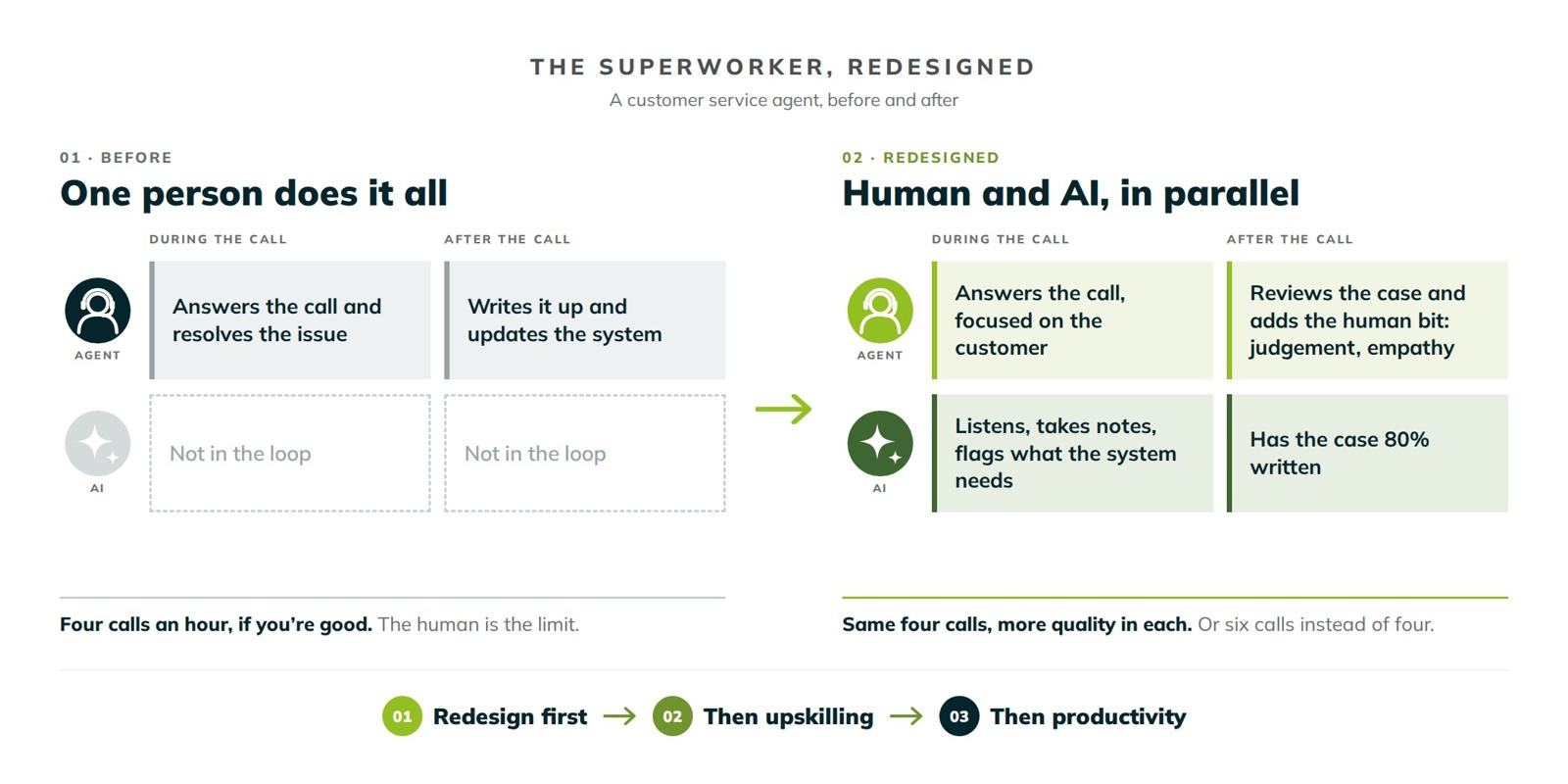
This can apply to anything that is rules-based and document-heavy, because you get the same pattern. So in finance, HR operations, contract review teams, all of it – the redesign comes first and then comes the upskilling. And that’s when you get increased productivity. Most organisations are trying to do it backwards: they skip the redesign, train people on the tool, then wonder why the productivity didn't increase in their business.
What this means in practice
If you’re sitting down right now to plan your skills strategy for 2027 and beyond, here are the five pieces we think it takes to build a superworker. They’re also the five conversations at the heart of the Skills & the Superworker pillar at Working Futures on 24 November.
- Treat skills as infrastructure, not a project. Most skills taxonomies fail because they’re run as projects built once, launched, then left to go stale. Treat yours as infrastructure instead and keep it current as roles change. Workforce planning then becomes role-by-role redesign, not a headcount forecast. For each role: where is AI sitting? How is the human working with it, not against it? What does that role need to learn to work that way?
- Build AI fluency, not just an AI policy. Most organisations now have an AI policy. Far fewer have people who are fluent. So your L&D plan shifts from “capability roadmap” to “learning velocity targets”. How fast can your people learn? How fast can you update what you’re teaching? Those become success metrics, not “trained 85% of the target audience”.
- Move skills to where the work is. Internal talent marketplaces promise to match people’s skills to the work that needs doing. Most stall, not because of the platform, but because managers hold on to their best people. Skills only create value when they’re allowed to move.
- Make managers teachers, and champions of mobility. Your manager development shifts from “leadership skills” to “teaching skills”. How do you help a manager get comfortable saying “I don’t know, let’s figure this out together”? That’s not a module, it’s coaching, practice and permission to be human. It’s also where mobility lives or dies: careers are becoming a series of experiences rather than a ladder, and it’s managers who decide whether people get to have them.
- Reskill at speed, and slow down your hiring. Slow down the hiring conversation long enough to sort out the learning conversation. Because if you’re growing headcount whilst you’re still figuring out how your roles work with AI, you’re onboarding people into outdated job descriptions. They’ll figure it out themselves eventually. But it’s slower, it’s messier, and it costs more. Build what you can first, using everything available to you, and hire for what you genuinely can’t build.
We’ll be taking all five into the room at Working Futures on Tuesday 24 November in London.
Register your interest in attending Working Futures here.
Part 3 of The Age of Continuous Transformation, our eight-part series in the run-up to Working Futures on Tuesday 24 November 2026. Read the full series →