Culture got the budget but can it prove it’s a performance lever?

Boards are now funding culture as part of transformation rather than as a perk which, whilst good for HR, also means culture will be judged like any other investment: on what it does for performance.
There’s a familiar moment in most budget rounds when the engagement survey comes back with a couple of scores that have dipped, leading to an action plan and maybe a values refresh. The money attached to it is usually modest and easy to trim when things get tight. But this year our research has suggested that something different is going on.
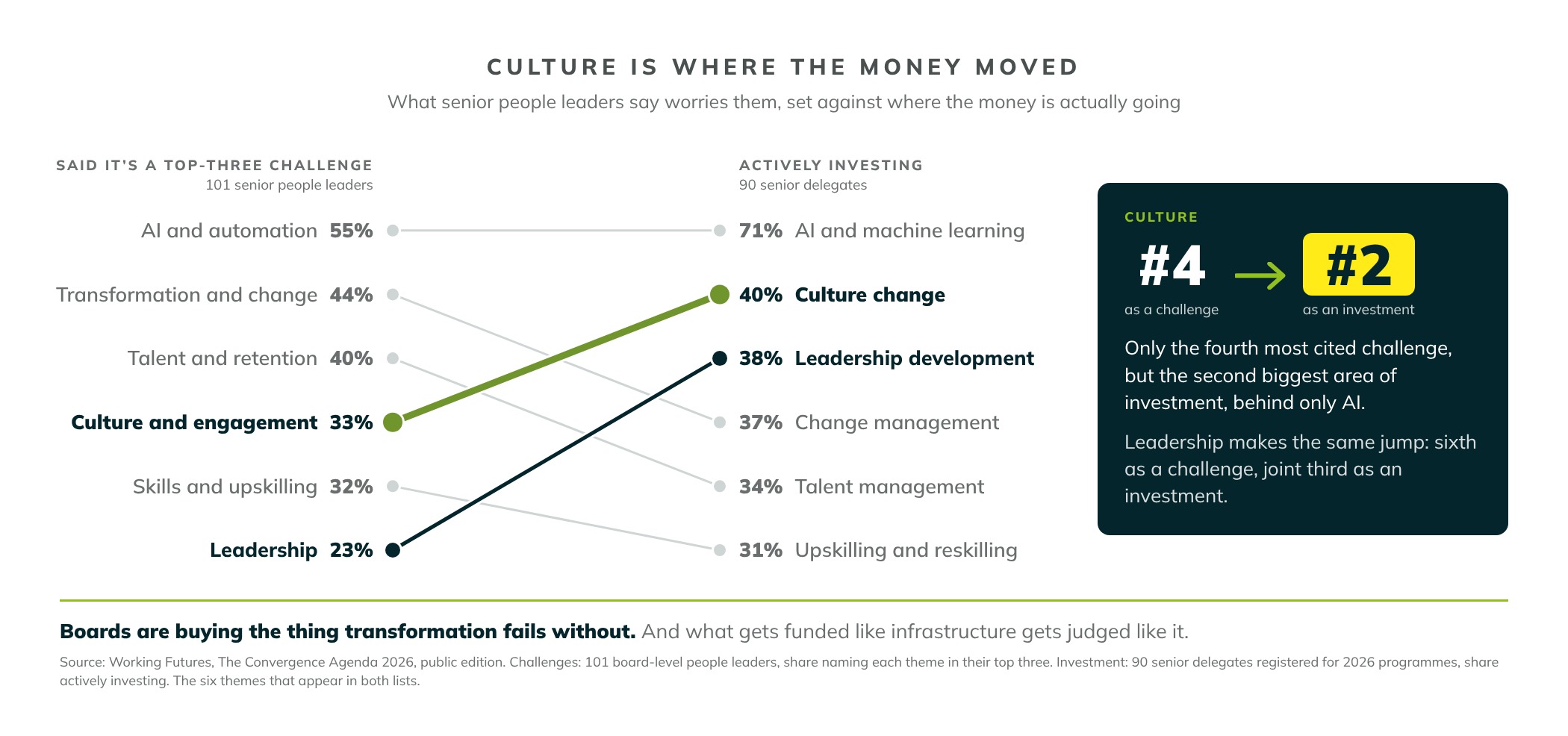
In our Convergence Agenda research, conducted with 101 senior people leaders, ‘culture and engagement’ was fourth on the list of top challenges (33%), behind AI, transformation and talent. Yet among the 90 senior delegates registered for our 2026 programmes, culture change is the second biggest area of investment (40%), behind only AI. Add employee experience (28%) and employer branding (24%), and the human side of the organisation is getting more money than its place on the worry list would suggest.
Why the money moved
We think it’s a lesson learned the hard way - plenty of the transformation programmes HR leaders have lived through haven’t come unstuck on the plan, but because the way people actually worked didn’t change with it. New structures, new systems and new processes end up sitting on top of the same old habits. Boards have noticed and culture is now being funded as part of the plumbing of transformation rather than as an engagement perk.
The catch is that anything funded like infrastructure gets judged like infrastructure, so culture budgets will now be asked the same question as every other line item in the plan:
“What did it change, and what did that do for performance?”
It’s a tough question to answer from where the UK is starting. Gallup’s latest State of the Global Workplace report puts engagement among UK employees at 10%, below the European average of 12%. The CIPD’s Good Work Index 2026, which surveyed more than 5,000 UK employees, found that only 42% feel inspired by their organisation’s core purpose, and fewer than six in ten say their manager gives them useful feedback or helps them perform well. Almost one in five (18%) say they’re likely to quit in the next 12 months, and when people do move on, unhappiness with leadership or senior management (19%) comes third, after pay and work-life balance.
Thomas, our headline partner, has looked at what this means in hard numbers. Their analysis of connection across 170 FTSE 250 organisations over five years found an 8.8 percentage point gap in five-year compound annual growth rate (CAGR). While the most connected organisations gained +4.9%, the least connected lost -3.9% in CAGR, with connection also explaining more than 3% of the variance in total shareholder return. Though not an exact match for culture, connection – composed of belonging, trust, wellbeing, cohesion, contribution and appreciation – provides a close proxy, showing how the conditions around employees can change their ability, or desire, to perform.
Culture shows up in teams, not on the wall
Part of the problem is where we tend to look for culture. It’s usually written down at the top of the organisation, in a values statement or a behaviours framework, measured once a year in a survey that produces one company-wide average. But people don’t experience culture as an average, they experience it in their own team:
- Whether they trust the people around them
- Whether anyone notices what they contribute
- Whether a disagreement gets sorted out or left to fester.
Thomas’ Luke Warren points out that this is where culture meets performance, and why it can have such a transformative effect: ‘it influences whether decisions get made quickly or slowly, and if good people decide to stay. Our own research shows that connection, and the dimensions behind it are highly influential in an employee’s intention to leave. If you’re not tracking that, how will you know who’s at risk?’
Without a culture that gives employees what they need to feel secure and valued, the discretionary effort that lies outside a job description lies tantalisingly out of reach. And there’s a strong chance you may never hear about half of what’s happening culturally. For example – a quarter of UK employees told the CIPD they’d experienced conflict at work, and just over half of them (51%) simply let it go. But where does that leave their relationships for the future?
“A values statement doesn’t change anything until someone can see it in how a team works on an ordinary Tuesday afternoon.”
Three tests for a culture budget
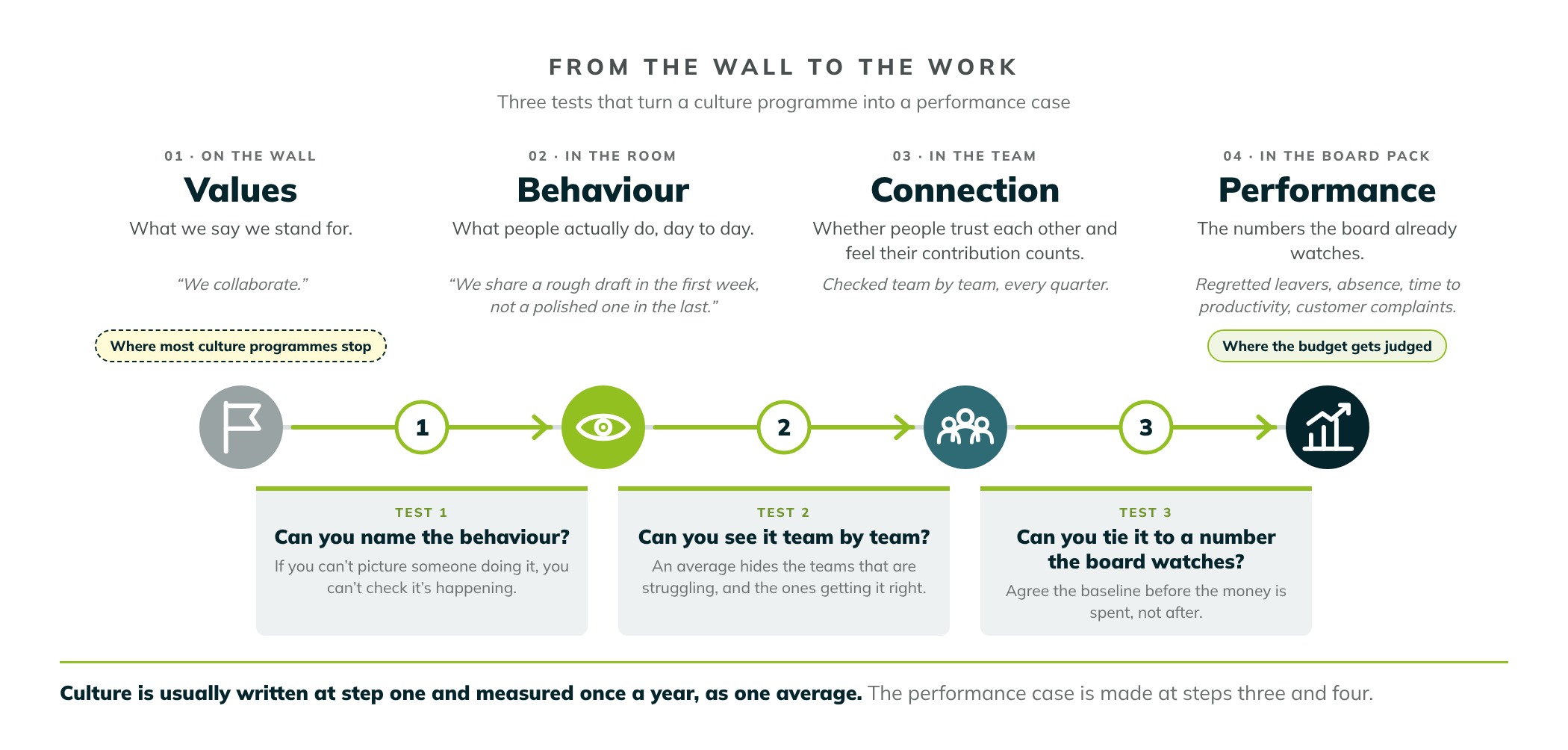
If culture is going to be judged as a performance lever, it needs measuring like one. Before the next round of culture spend, we’d put each programme through three tests:
- Can you name the behaviour or track the value? ‘Collaboration’ is a value – ‘we work closely with other teams to get the job done’ is a behaviour – although a little more abstract to measure. Put the right tools and metrics in place to track your culture and its behaviours before you commit the budget.
- Can you see it team by team? A company-wide average hides the teams that are struggling as well as the ones doing brilliantly. Measure at team level, and often enough to act on what you find; a short check every quarter will tell you more than a long survey once a year. Look beyond engagement – it’s a lagging metric, and culture can change fast.
- Can you tie it to a number the board already watches? Regretted leavers, absence, how long new starters take to get up to speed, customer complaints. 56% of an employee’s intention to leave can be explained by how connected they feel, which works as an early indicator of the regretted-leavers number most boards already track (Thomas Connection Research, 2025). Pick one or two measures for each programme and agree the baseline before the money is spent.
None of this means turning culture into a spreadsheet. It means treating it with the same seriousness as any other investment, so that it survives the next budget round on evidence rather than goodwill.
One more number from our research deserves attention. Only 7% of leaders now put DE&I in their top three challenges, a sharp retreat from the years when it led the people agenda. We read that as inclusion being folded into wider culture work rather than dropped, but if that’s the case, it needs its own measures inside the culture budget or it will quietly disappear.
Keeping the loop turning
In Part two of our series we set out the continuous transformation loop with culture as one of the steps that helps people work in a new way. In practice, it’s the step that decides whether each turn of the loop sticks. Change the work, the structure or the manager’s job without changing the habits underneath, and the old way of working quietly comes back. Next Friday, in the final part of the series, we turn to reward, pay and productivity, and why being aware of the Employment Rights Act isn’t the same as being ready for it.
Taking it into the room
Culture, Engagement & Performance is one of the seven pillars at Working Futures on Tuesday 24 November in London, where Thomas is our headline partner. Its five sessions take these questions on directly, from turning values into everyday behaviour and linking wellbeing spend to performance, to making inclusion measurable and agreeing how hybrid teams work together.
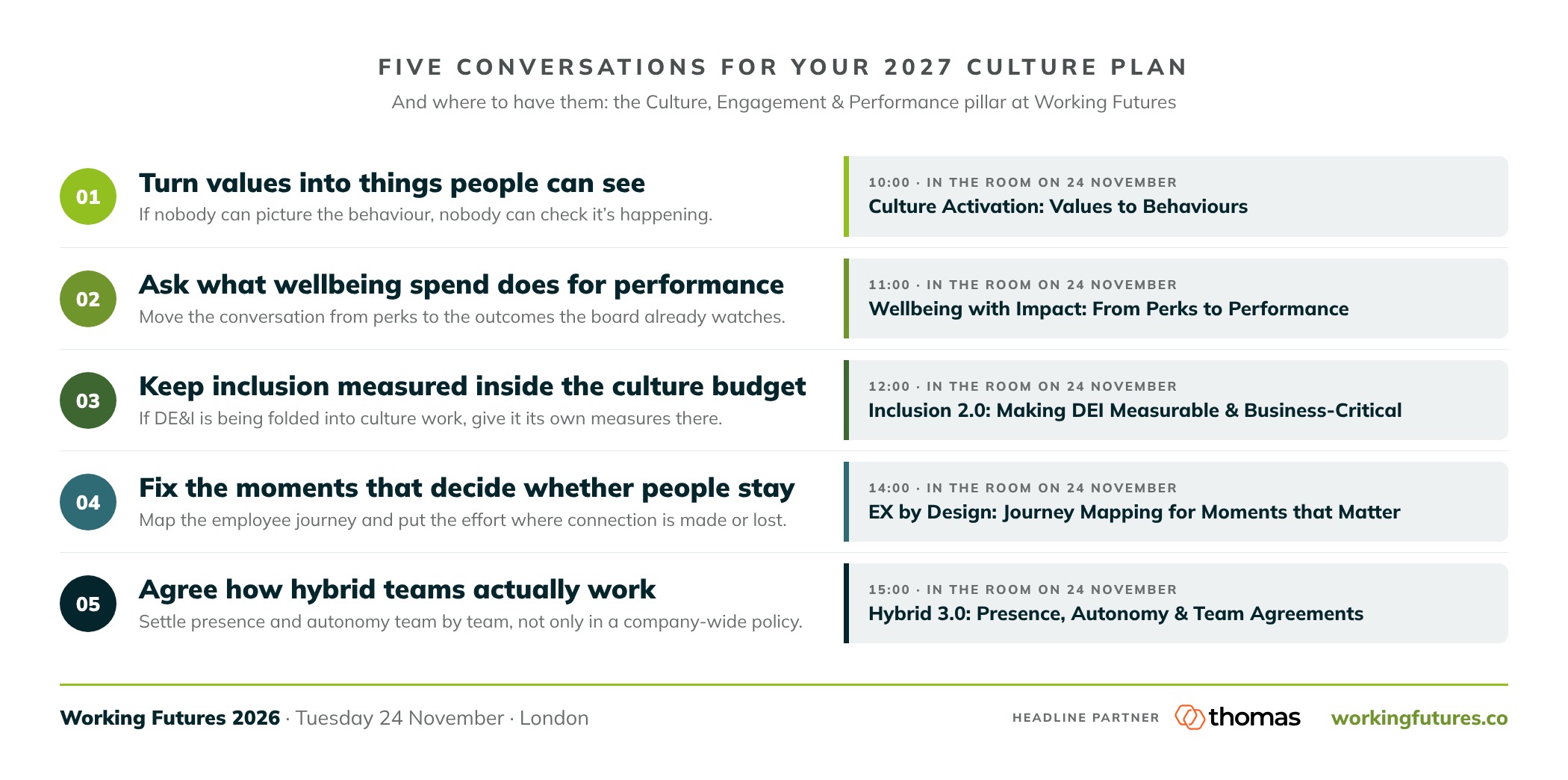
We’ll be taking all five into the room on the day. Register your interest here.
Part 7 of The Age of Continuous Transformation, our eight-part series in the run-up to Working Futures on Tuesday 24 November 2026. Read the full series →