Why does every transformation programme still have an end date?

Your next transformation starts before the last one has finished
 Ask an HR director when their last transformation programme finished. If they pause, it is because it hasn’t and it probably won’t. The restructuring might have closed, but the operating model work carried on. The system went live, but adoption is still being chased (and depending on the business, will be a never-ending story). The skills programme is in year two of three and the reason it was commissioned has already moved.
Twice a year, Working Futures sits down with more than 200 CHROs, CPOs and HR directors and asks a deliberately unglamorous question:
what is really on your desk right now? Not what is on the horizon, but what you have been asked to deliver, and what is getting in the way.
The model that used to work
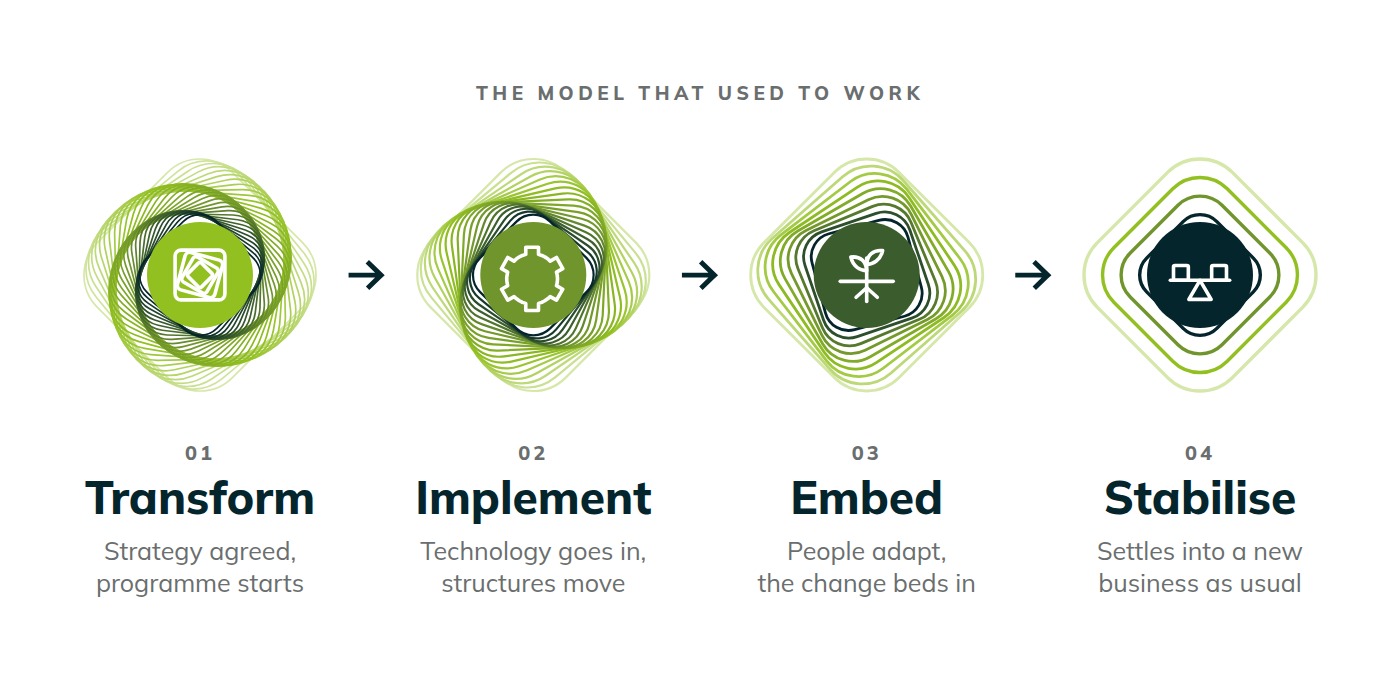
For most of the last thirty years, transformation has been treated as something ‘with edges’, i.e. a strategy is agreed, a programme starts, technology goes in, structures move, people adapt, and eventually the organisation settles into a new version of ‘business as usual’. Transform, implement, embed, stabilise. That held up well, with periods of significant change followed by periods of relative quiet.
The ‘quiet’ has gone. AI is changing how work gets done and how decisions get made. Skills are going obsolete faster than most organisations can build replacements. Cost and productivity pressure is asking for more output from fewer people. Regulation is arriving behind the technology rather than ahead of it. And the shape of the workforce itself is changing, in who is available, on what terms, and for how long.
None of that is new on its own. What is new is that it is landing on the same teams, in the same quarter, and each one moves the others. Introduce AI and you change the skills you need. Change the skills and you change the jobs. Change the jobs and you are redesigning the organisation. Redesign the organisation and what you need from your managers changes. What you ask of your managers shapes the culture. And a differently shaped workforce needs a different approach to reward.
The traditional model assumes you can move from one reasonably stable state to another. The difficulty is that the destination keeps moving while you are walking towards it.
Here is a question worth considering:
If there is no longer a reliable period of stability to come back to, can transformation still be something an organisation periodically does? Or does it have to become something an organisation continuously holds?
We have started calling this ‘Continuous Transformation’ (mainly because we needed something to call it).
The same seven messages over and over…
Looking across this year’s conversations that we’ve had with senior HR leaders, and the same seven areas keep coming up, so we’ll be exploring these in depth at this year’s event:
- AI, data and responsible HR tech. How do you get value out of AI and data without giving away governance, trust or human judgement?
- Skills, mobility and internal marketplaces. How do you keep building and redeploying capability when what you need keeps changing underneath you?
- Org design, operating models and workforce agility. How do you design an organisation that has to keep redesigning itself?
- Leadership, managers and team effectiveness. What do managers need when they are asked to deliver this year’s numbers and next year’s change at the same time?
- Culture, engagement, inclusion and wellbeing. How do you hold trust and belonging together when people are living through continuous change?
- Total talent, workforce ecosystems and automation. What do you build, buy, borrow, partner or automate, and who actually decides?
- Reward, pay, productivity and workforce economics. How do you rethink reward when the economics of work are themselves moving?
These are not seven separate HR agendas that happen to share a function, they are connected systems, and if you move one you’ll feel it somewhere else. It might happen in two-quarters’ time, with a team that wasn’t consulted, which will only end in more people challenges than you bargained for.
HR as the key driver of building organisational transformation capability
There is a consequence in all this. Organisations cannot ‘buy in’ every transformation they are going to need. External expertise remains valuable and will stay valuable (if sometimes a little costly if you don’t find the right partner). But if change is continuous, then the ability to understand it, redesign work around it and implement it must live inside the organisation, because there is no longer a quiet period in which to go out and find it.
That changes what HR is for. Supporting transformation is no longer the job. Building the organisation’s capacity to keep transforming might be.
In the run-up to our November event, we will take each of the seven in turn and set out what we are hearing: what is changing, what organisations are trying to solve, where they are getting stuck, and what appears to be working. Some of it is uncomfortable. Very little of it is theory.
The conversation continues in London
On 24 November, Working Futures brings senior HR leaders, practitioners and experts together in London to put these questions to each other in person. The same seven themes run through the agenda.
Part one of our ‘Continuous Transformation’ campaign in the run up to Working Futures.