Is talent acquisition still about filling vacancies?

Candidates are applying with AI and employers are screening with it, but what are the talent attraction team really looking for?
The buzzword of the last few years when it comes to graduate recruitment is: volume.
The Institute of Student Employers recorded 140 applications per graduate vacancy in 2025, which was the highest figure in more than three decades. Prospects found 73% of students and graduates used AI when applying, and 27% of employers told the CIPD they’d seen ‘excessive’ use of generative AI in applications; what we’re seeing is the ability to fast-track the process, causing a tidal wave of submissions as young people try to ‘spread the net further’ by firing out more CVs and cover letters than ever previously possible.
But employers screen with AI too, and as a result, the two largely cancel each other out. The same CIPD report found 58% of employers had seen a rise in unsuitable applicants, against 33% who’d seen more suitable ones.
On paper, hiring should be getting easier, and UK vacancies are 10.9% below their pre-pandemic level according to the ONS, with the share of organisations struggling to attract candidates, falling from 77% in 2022 to 53%. More people are looking and the right person is still harder to find.
AI is changing how we hire. That’s the smaller story
AI is rebuilding the mechanics of recruitment tool by tool, whether that’s sourcing, screening, scheduling or assessment. But in our conversations with over 200 HR leaders ahead of Working Futures 2026, the bigger shift wasn’t how organisations hire, it was whether hiring is the answer at all.
In our Convergence Agenda research with 101 senior people leaders, talent attraction, retention and succession is the third-biggest challenge, named by 40%. Follow the money and the picture changes, because delegates registered for our 2026 programmes have told us that talent management (34%), upskilling (31%) and workforce planning (38%) all outrank pure acquisition of people. The centre of gravity has moved from competing for people in the open market, to building, keeping and redeploying the people you have. As one HR leader put it, the challenge is “talent shortage and the shift needed in talent profile”.
Our investment data from before the pandemic onwards shows something else: talent funding rises and falls with the labour market, not with strategy. When the market tightens, the instinct is to compete for the same scarce people again. We call it the ‘buy-reflex’ – an expensive habit.
From filling vacancies to sourcing capacity
Most organisations already have a total workforce, they just don’t manage it as one, i.e. permanent hires go through talent acquisition, contractors and temps through procurement, internal moves happen (or don’t) at line managers’ discretion and automation sits with IT. Four routes to getting work done, four budgets, four sets of data and no ‘single picture’ perspective.
The ‘other’ workforce isn’t small either; the ONS counts 1.62 million temporary employees and 1.23 million people on zero-hours contracts, and the REC estimates around 872,000 temps and contractors are on assignment on any given day. The CIPD found 29% of employers have replaced some jobs with technology, rising to 46% of large private sector organisations. The CIPD’s advice is plain:
“The most effective approaches integrate permanent and contingent workforce decisions, job design and investment trade-offs into a single planning framework.”
One vacancy, five routes
Say your HR operations team loses its senior payroll specialist four months before a new payroll system goes live. The old answer is: advertise the same job description, sift the pile, run two rounds of interviews, make an offer and wait for the three-month notice period to come to an end. You end up with a like-for-like replacement for a role that’s about to change anyway.
The ‘total workforce’ answer starts with the work, not the job title, asking five questions in order:
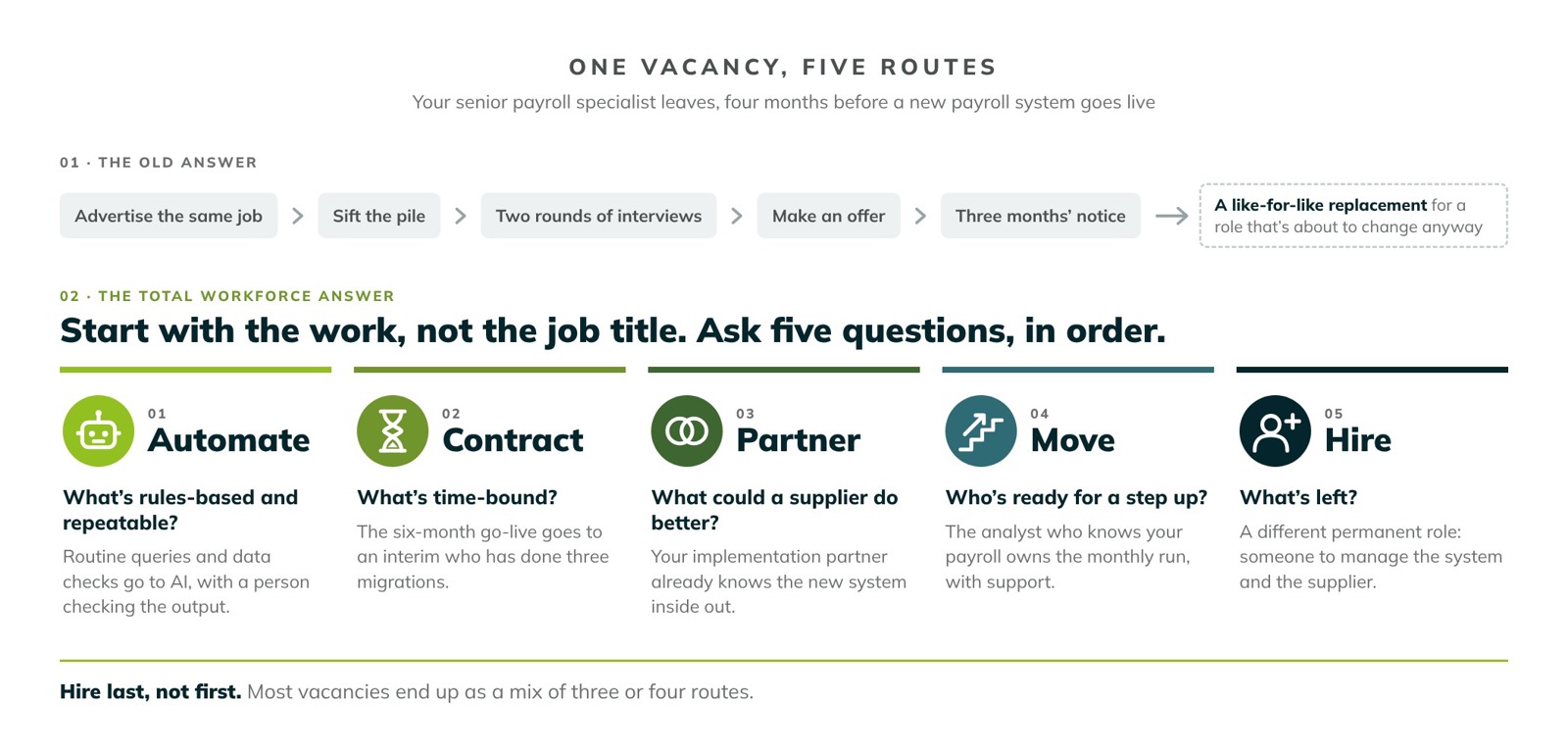
This fits how careers work now, too: Randstad’s Workmonitor found 78% of UK employers agree the linear career ladder is outdated. Talent acquisition stops being the team that fills vacancies and becomes the team that decides where capacity comes from.
The rules are tightening on every route
However, just as the contingent workforce becomes more useful, it’s getting harder to manage at arm’s length:
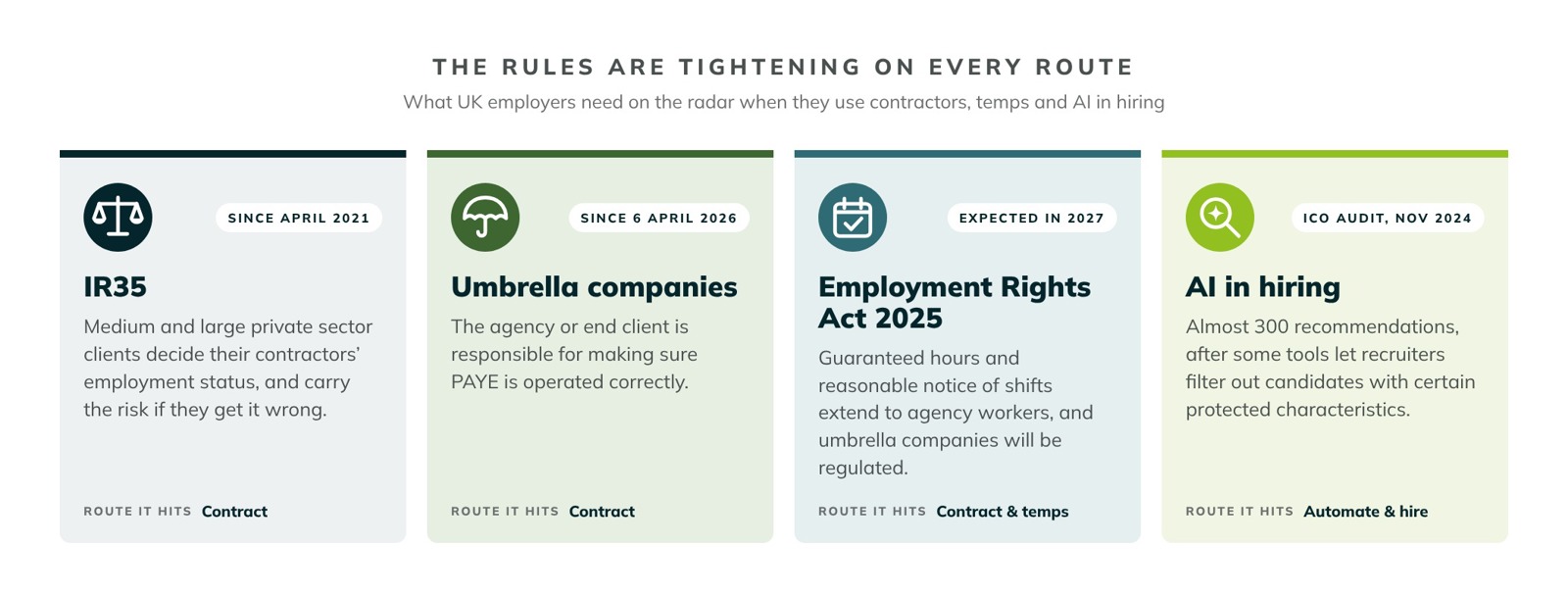
Sources: HMRC, off-payroll working (IR35) · HMRC, umbrella company PAYE rules · Employment Rights Act 2025 · Implementation timeline · ICO audit of AI recruitment tools
15% of employers told the CIPD the Act will make them more likely to hire temporary rather than permanent workers. So the contingent workforce may grow just as it carries more legal risk. If it lives in a procurement spreadsheet HR never sees, that’s a board-level exposure, not an admin problem.
What this means
If you’re planning your 2027 talent strategy, these are the five conversations we think matter most. They’re also the five sessions in the Talent Acquisition & the Total Workforce pillar at Working Futures on 24 November.
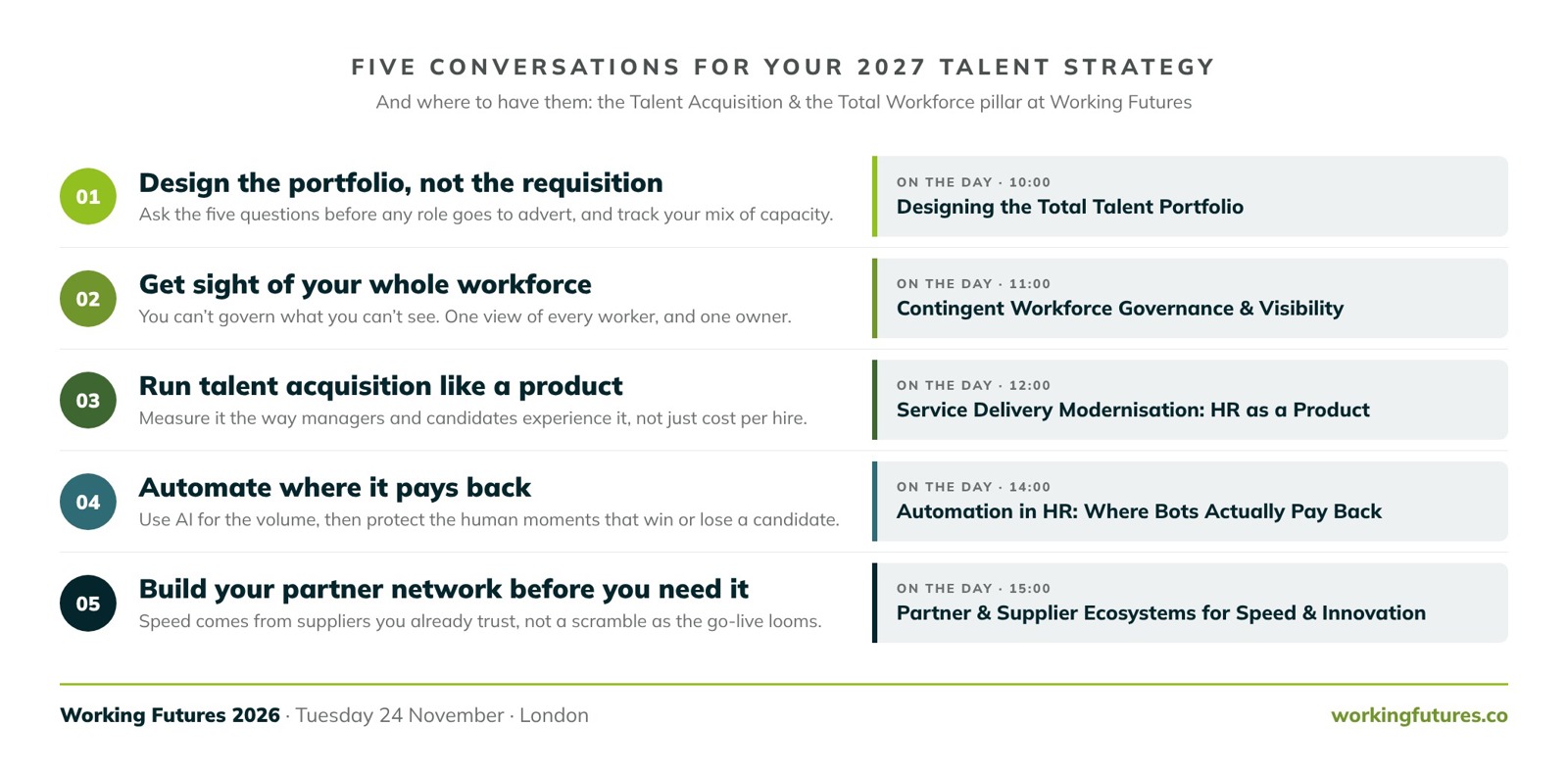
We’ll be taking all five into the room at Working Futures on Tuesday 24 November in London.
Part 4 of The Age of Continuous Transformation, our eight-part series in the run-up to Working Futures on Tuesday 24 November 2026. Read the full series →